
Ceiling Water Damage Repair in Memphis, TN
That brown ring on your ceiling is telling you something — and it’s not “buy more paint.” Ceiling water damage is almost always a symptom of a leak somewhere above, and in Memphis homes the culprit is usually plumbing, not weather. Here’s how to read what your ceiling is saying, what the repair actually involves, and when it’s a job for a professional.
What ceiling water damage looks like
- Brown or yellow stain rings — often with darker edges. The classic first sign.
- Sagging or bulging drywall — water pooling above, pushing the ceiling down.
- Bubbling or peeling paint — moisture trapped under the finish.
- A musty smell in the room — mold may already be growing inside the cavity.
In Memphis’s 60–80% humidity, a wet ceiling cavity can start growing mold within 24 to 48 hours. The stain you can see is often the smallest part of the problem — moisture meters usually find the water spread well beyond the visible ring.
What causes it
- Upstairs bathroom leaks — the single most common cause in Memphis two-story homes: failed wax rings, loose supply lines, cracked shower pans, overflowing tubs.
- Roof leaks — worn flashing, missing shingles, storm damage letting rain into the attic and down through the ceiling.
- AC condensate lines — clogged condensate drains in attic air handlers drip steadily onto ceiling drywall. A very Memphis problem, given how hard air conditioners run here.
- Burst supply lines — the freezes of February 2021 and January 2024 burst plenty of upstairs pipes, and gravity did the rest.
If the source is a burst pipe, see our burst pipe repair guide — the line repair and the ceiling repair are two jobs that coordinate, not compete.
Can you just paint over a water stain?
Short answer: no — at least not as the fix. A stain-blocking primer covers the discoloration, but it does nothing about the moisture still in the drywall or the mold that may be growing in the cavity. Paint over a still-wet ceiling and the stain bleeds back through within weeks — and you’ve sealed moisture inside a dark cavity, which is exactly what mold wants.
The stain is a symptom; the repair starts with finding and stopping the source. Our water damage signs guide covers what else to look for while you’re investigating.
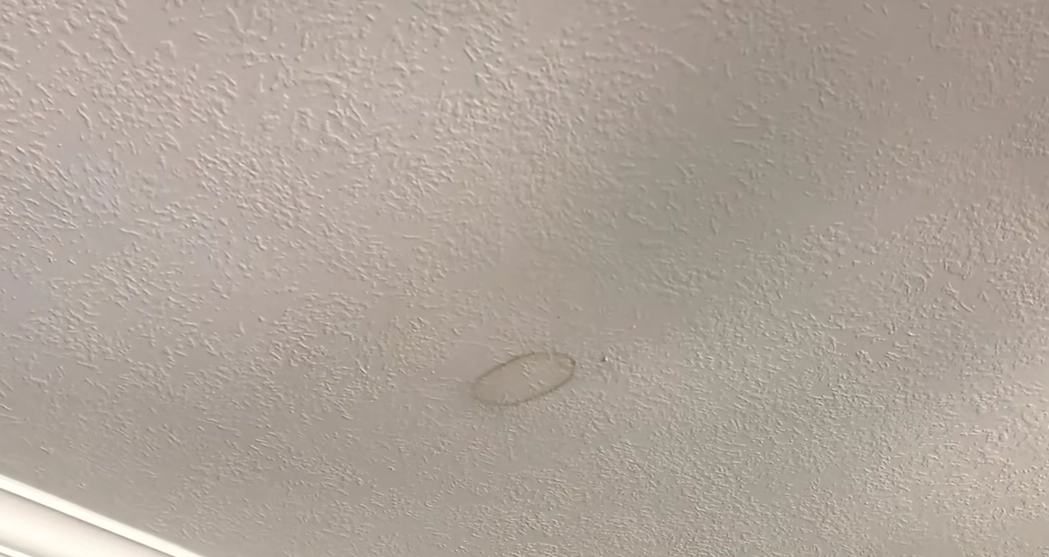
How ceiling water damage gets repaired
- Find and stop the source. A plumber for supply and drain lines, a roofer for roof leaks, an HVAC tech for condensate issues. Drying a ceiling while water is still entering is pointless.
- Assess the damage. Moisture meters show how far the water spread beyond the visible stain. Sagging drywall has almost always lost its structural integrity and has to go.
- Remove what’s ruined. Saturated drywall gets cut out — typically a clean rectangle to the nearest framing for a proper patch — along with any wet insulation above it.
- Dry the cavity. The framing, joists, and surrounding drywall need to reach verified dry standards, not just “feels dry.” Drying logs and meter readings are what confirm it.
- Replace and finish. New drywall, tape, mud, texture match, prime, paint — done so the repair disappears.
For what this kind of work typically costs, see our water damage restoration cost guide — it breaks down the national benchmarks and how to read an estimate.
When to call a professional
- The ceiling is sagging or bulging — that’s pooled water with real weight behind it. It can collapse.
- The damaged area is large — more than a couple of square feet, or spreading.
- You smell mustiness or see mold — the cavity needs proper remediation. See mold remediation in Memphis.
- Plaster ceilings in older Memphis homes — plaster behaves differently from drywall, and older homes deserve careful handling.
- You can’t find the source — chasing an intermittent leak without meters wastes weekends.
Call (901) 286-9686 if any of these sound familiar — an assessment finds the source and the full extent before the repair starts.
Ceiling water damage questions — straight answers
How do I know if my ceiling water damage is serious?
Size, sag, and smell. A small, dry, stable stain ring from a fixed leak is usually cosmetic once the source is confirmed stopped and the area is verified dry. Sagging, bulging, active dripping, spreading stains, or a musty odor mean water is still in the cavity or mold is growing — that’s professional territory. When in doubt, a moisture inspection settles it.
Can I just paint over a water stain on my ceiling?
Only after the source is fixed and the area is verified dry — and even then, use a stain-blocking primer first or the ring bleeds through. Painting over an active leak or a still-wet ceiling just hides the problem while mold grows in the cavity. The section above explains why the source comes first.
How much does ceiling water damage repair cost?
It depends on the source, the size of the damaged area, and the materials — a small drywall patch after a fixed leak is a very different job from a collapsed ceiling with mold in the cavity above it. We don’t publish flat prices because every ceiling is different; national cost benchmarks are a starting point, and the only accurate number comes from an assessment of your specific damage. Call (901) 286-9686 to request one.
My ceiling is sagging — is it going to collapse?
A sagging ceiling is holding pooled water, and yes, it can collapse — sometimes suddenly. Don’t poke it or push on it. Put a bucket underneath, keep people and pets out from under it, and call for professional help promptly: (901) 286-9686. If water is dripping near light fixtures, turn off the breaker for that room.
Ceiling stain, sag, or drip? Don’t wait on it.
Water in a ceiling cavity doesn’t get better on its own — in Memphis humidity it gets worse, fast. Call (901) 286-9686 to request an assessment: find the source, verify the extent, dry it properly.
Memphis Water Damage Restoration · 4040 Delp St, Memphis, TN 38118 · (901) 286-9686 · Serving Memphis, Shelby County & the Mid-South