Emergency Water Removal in Memphis, TN
Standing water doesn’t negotiate. Whether it’s a burst supply line spraying behind a wall in Cooper-Young, a washing machine overflow spreading across the hallway in Hickory Hill, or a flash flood pushing into a basement during a Midtown downpour — the water is doing damage right now, not tomorrow.
In Memphis, that damage moves faster than most homeowners expect. With summer humidity running between 60% and 80%, mold can begin growing on soaked drywall within 24 to 48 hours. Emergency water removal is the first, non-negotiable step of every water damage job: getting the bulk water out fast so that everything after it — drying, cleaning, rebuilding — has something to work with.
Emergency water removal services are available across Memphis, Shelby County, and the surrounding Mid-South. If water is in your home right now, call (901) 286-9686 to request help — a fast call is the cheapest thing that will happen to your restoration bill.
Why speed matters more in Memphis than most places
Water damage follows the same physics everywhere, but Memphis adds two accelerants.
The first is humidity. The industry rule of thumb is that mold can take hold within 24 to 48 hours of water exposure — and Memphis spends its summers sitting at 60% to 80% humidity, the perfect incubator. A damp spare room here doesn’t dry; it breeds.
The second is what the water hides in. Drywall wicks standing water upward like a sponge, so a flooded floor becomes a soaked wall. Hardwood cups and buckles as it absorbs moisture unevenly. Insulation behind walls holds water invisibly. In a city where much of the housing stock was built around 1979 — well before modern waterproofing was standard — there are plenty of older materials eager to hold onto water where you can’t see it.
The job that could have been a same-visit extraction becomes a tear-out-and-rebuild job in a matter of days. The cheapest restoration is the fastest one.
What causes emergency water removal calls in Memphis
The same handful of culprits show up over and over, in every Memphis zip code:
Burst pipes and supply-line failures. The February 2021 and January 2024 freezes burst pipes across the Mid-South in single nights, and smaller freezes keep doing it every winter. Supply lines in attics, crawlspaces, and exterior walls are the usual victims. If water is spraying or pouring, this is the call.
Appliance failures. Water heaters, washing machines, dishwashers, and refrigerator supply lines are among the most common causes of indoor flooding — no storm required. A failed washing machine hose can discharge gallons a minute while you’re at work.
Storm intrusion and flash flooding. Memphis averages about 55 inches of rain a year, most of it arriving in violent spring and summer bursts. When the April 2025 storms dumped 14+ inches on East Memphis in a matter of days, basements flooded across the metro. Neighborhoods bordering Nonconnah Creek, the Wolf River, and the Loosahatchie River are especially vulnerable when the waterways back up — and the 2011 Mississippi River flood showed how tributary backwater can reach thousands of properties even when the river itself isn’t at your door.
Sewage backups. When heavy rain overwhelms the system, wastewater can push back into lower-level drains. This isn’t a gray-water situation — it’s black water, and the cleanup follows a different protocol entirely (see below).
Roof leaks and storm damage. Torn-up shingles and wind-driven rain let water travel down walls and into ceilings, often showing up rooms away from the actual entry point.
Call (901) 286-9686 to request emergency water removal
What to do while you wait
You can genuinely reduce the damage before help arrives — safely. Here’s what professionals want you to do:
- Stay out of standing water if there’s any chance of electrical contact. Never touch water near outlets, switches, or a submerged breaker panel. If you can safely shut off electricity to the affected area, do so. If you can’t do it safely, don’t do it.
- Stop the source if you can. For a burst pipe, that’s your main water shutoff valve. For an appliance, shut the appliance’s valve and unplug it if safe.
- Photograph everything — the water at its worst, the source if visible, damaged belongings where they lie. Your insurer pays for documented damage; memory isn’t documentation.
- Move valuables and dry what you can reach. Small rugs, electronics, and furniture legs off wet carpet. Don’t wade into contaminated water to do it.
- Don’t use a household vacuum on water. It will destroy the vacuum and create a shock hazard.
- Don’t wait for it to “dry out.” Water inside walls and subfloors doesn’t dry on its own — it migrates, feeds mold, and rots framing.
For the full numbered walkthrough, see What to do in the first 30 minutes.
How professional emergency water removal works
Legitimate water removal follows the same professional sequence everywhere — the same five phases recognized across the restoration industry. Knowing them helps you tell a real operation from a guy with a shop vac:
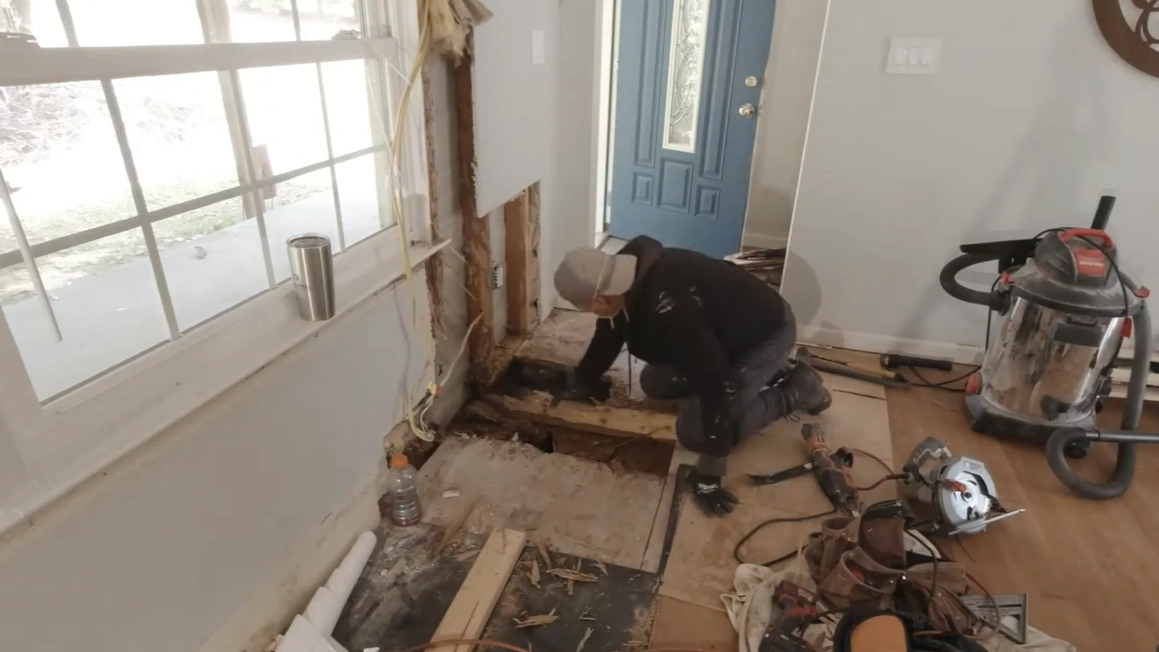
1. Inspection and moisture mapping. The visible water is only part of the story. Professionals locate the full extent — water inside walls, under flooring, above ceilings — using moisture meters (penetrating and non-penetrating types) and thermal imaging cameras. Hidden moisture is what becomes mold in 48 hours.
2. Water extraction. This is the emergency phase proper: standing water removed with submersible pumps and extraction equipment. The faster the bulk water is out, the less demolition your home needs later. Every subsequent step depends on this one being done thoroughly.
3. Structural drying and dehumidification. Air movers and industrial dehumidifiers create controlled airflow that pulls moisture from drywall, subfloors, framing, and hardwood. Professional drying is verified with moisture meters and drying logs — your home is done drying when the readings say so, not when a calendar does.
4. Cleaning and sanitizing. Category-aware cleaning (see the table below): clean water gets dried; gray and black water get antimicrobial treatment, disinfection, and removal of unsalvageable porous materials.
5. Restoration and reconstruction. Drywall, flooring, paint — the rebuild to pre-loss condition.
One warning sign worth knowing: any company that quotes you a flat price over the phone for the whole job — extraction through rebuild — is guessing. A written, line-item estimate that separates mitigation (steps 1–4) from reconstruction (step 5) is how honest pricing works.
Know your water: clean, gray, and black water
The industry-standard IICRC S500 categories classify water by contamination — and the category decides the safety protocol, what materials can be saved, and roughly what the job costs per square foot:
| Category | What it is | Typical Memphis sources | What cleanup requires |
|---|---|---|---|
| Category 1 — clean water | Water from a sanitary source; no significant contaminants | Burst supply lines, overflowing sinks | Fast extraction and drying; many materials can be dried in place |
| Category 2 — gray water | Contaminated water with chemical or biological content | Washing machine or dishwasher overflow, toilet overflow without solids, storm runoff through walls | Antimicrobial treatment required; some porous materials (carpet pad, insulation) must be removed |
| Category 3 — black water | Grossly contaminated; carries bacteria, viruses, parasites | Sewage backup, external flooding, rising groundwater | Full protective protocol, containment, mandatory disposal of every porous material the water touched — drywall, carpet, insulation below the water line all come out |
Two things to know about categories: a job can be reclassified. Clean supply-line water that sits long enough — or contacts a floor drain — can be rerated to Category 2 or 3, and the rate follows. Speed doesn’t just reduce damage; it can keep your job in a cheaper category.
What emergency water removal costs (honest numbers)
Here’s what we can tell you honestly, with every figure labeled for what it is: a national benchmark, not a Memphis quote. No Memphis-specific pricing dataset exists, and any site giving you a flat “Memphis price” is guessing.
- Nationally, homeowners pay an average of about $3,860 for water damage restoration, with most jobs landing between $1,380 and $6,370 (Angi, 2026 data from 1,500 verified projects).
- Per-square-foot benchmarks by water category: Category 1 around $3–$4/sq ft, Category 2 around $4–$6.50/sq ft, Category 3 around $7–$7.50+/sq ft.
- Emergency after-hours dispatch can add a surcharge — nationally around $120–$600/hour. Ask whether it applies before authorizing night work.
What moves your number up or down: the water category, the square footage affected, the materials involved (drying hardwood costs more than drying tile), and above all, delay — every 24 hours of standing water in 60–80% humidity adds secondary damage. Reconstruction (rebuilding drywall, flooring, finishes) is a separate part of the bill from mitigation, nationally around $20–$37/sq ft.
Your real number comes from a written, on-site assessment. Read our honest cost guide for water damage restoration for how to read an estimate and the red flags that signal a dispute waiting to happen — including the verbal-estimate trap behind real documented cases where a “$1,000–$3,000” spoken figure became a $5,100 invoice.
Insurance and emergency water jobs
Sudden and accidental water damage — burst pipes, appliance failures, storm intrusion — is typically covered by standard homeowners insurance. Gradual damage (a leak you’ve been ignoring for months) usually isn’t. External flooding and groundwater seepage are excluded without separate NFIP flood insurance — a distinction that matters enormously in a river city, where a homeowner in Frayser or near Nonconnah Creek may be surprised to learn that river water and pipe water are different policies entirely.
Two things decide your claim: documentation (photos, moisture readings, a professional assessment from day one) and speed (mitigate immediately — insurers penalize delays). See the full insurance claims playbook for the sudden-vs.-gradual distinction, deductible math, and what to hand your adjuster.
Preventing the next emergency
Once the water’s out, it’s worth ten minutes of prevention:
- Know where your main water shutoff valve is. Every minute of flow adds square footage to the bill. In many Memphis homes the meter is near the curb; the interior shutoff is often in a utility or laundry room.
- Consider leak detectors — the sensor devices that shut off water when they sense a leak. Homeowners who’ve been through multi-month restorations from toilet overflows often call this the cheapest insurance they’ve ever bought.
- Keep gutters clear and downspouts extended away from the foundation — especially critical in Germantown, where clay soil holds water against foundations instead of draining it.
- Maintain your sump pump (and add battery backup) if you’re in Midtown or another area with a high water table.
For the seasonal checklists — spring storm prep, winter freeze prep — see how to prevent water damage.
If the water is coming from a burst or leaking water heater, our Memphis water heater leak guide walks through shutting it down safely before cleanup starts.
How does emergency water removal work?
Extraction comes first: professionals remove standing water with submersible pumps and extraction equipment, then map hidden moisture with moisture meters and thermal imaging. Next is structural drying — air movers and dehumidifiers run until readings confirm materials are dry, verified in drying logs. Cleaning and sanitizing follow (category-aware), and finally reconstruction rebuilds what was removed. The whole sequence is standardized across the industry.
How long does emergency water removal take?
The extraction itself often takes a few hours once equipment is on-site. Full structural drying typically takes 3–5 days with professional air movers and dehumidifiers, depending on water depth, materials, and humidity. Concrete and framing dry slower than you’d expect — “feels dry” is not dry. Professionals verify with moisture meters, so you get proof, not a guess.
How do I find emergency water removal services near me?
Look for three things: a written, line-item estimate before work begins (never a verbal range), insurance-grade documentation from visit one (photos, moisture readings), and a process that separates mitigation from reconstruction so you can compare quotes fairly. Be wary of flat phone quotes and pressure to sign immediately. Emergency water removal services are available across Memphis, Shelby County, and the Mid-South — call (901) 286-9686 to request help.
What should I do if my basement is flooding?
First, stay out of standing water if there’s any chance of electrical contact — never touch water near outlets or a submerged breaker panel. Shut off electricity to the area if you can do so safely. Stop the source if it’s a burst pipe (your main shutoff valve), photograph everything for insurance, then call for professional extraction. Don’t wait for it to “dry out” — water inside walls and subfloors won’t, and in Memphis humidity mold can start within 24 to 48 hours.
How much does emergency water removal cost?
Nationally, most homeowners pay $1,380–$6,370, averaging about $3,860 (Angi 2026). Your job depends on the water category (clean water around $3–$4/sq ft; sewage or floodwater around $7–$7.50+/sq ft), square footage, and materials. After-hours dispatch can add a surcharge (nationally ~$120–$600/hour). These are national benchmarks, not Memphis quotes — the only accurate number is a written, on-site estimate.
Water in your home right now? Act on it now.
Every hour of standing water is more damage, more mold risk, and a harder insurance conversation. If the water is in, the time is now.
Call (901) 286-9686 — Request Emergency Water Removal
Memphis Water Damage Restoration · 4040 Delp St, Memphis, TN 38118 · Serving Shelby County & the Mid-South