
Flooded Basement & Crawlspace Water Damage in Memphis, TN
Water in the basement doesn’t negotiate. It wicks up drywall, swells the bottom plates, and — in a Memphis summer at 60–80% humidity — starts feeding mold within 24 to 48 hours. Under the house, a damp crawlspace does its damage quietly: joists drinking moisture year-round, and that musty smell when the AC kicks on.
Standing in water or smelling something off? Here’s what Memphis homeowners need to know. Services are available across Memphis and Shelby County — call (901) 286-9686 to request emergency water removal or an assessment.
Why Memphis basements and crawlspaces flood
Memphis basements flood the way Memphis floods — and the reasons are local.
In Midtown, the water table runs high — and much of the housing stock in Cooper-Young, Chickasaw Gardens, and around Overton Square predates modern waterproofing. With a median home build year of 1979, a 50-year-old basement in a high-water-table neighborhood is living on borrowed time every storm season.
Then there’s what’s under your feet. Germantown’s clay soil holds water against foundations instead of draining it — which is why grading soil away from the foundation is the constant refrain on that side of town. Saturated clay pushes water sideways against basement walls, and that pressure — hydrostatic pressure — forces groundwater up through floor cracks and the seam where the wall meets the slab.
The waterways compound it. Neighborhoods bordering Nonconnah Creek sit in flood-insurance zones and often rely on elevated drainage systems, and the Wolf River and the Loosahatchie send backwater into low areas when the Mississippi runs high — tributary backwater was a major part of why roughly 3,000 properties flooded in May 2011. Storm season runs late spring through early fall, peaking April through September; in April 2025, flash flooding dumped 14+ inches on East Memphis in days. Memphis averages about 55 inches of rain a year across roughly 112 precipitation days, much of it in bursts the drainage system can’t swallow.
Under the house, the story is just as local: USDA research has ranked Memphis crawlspaces among the worst in the country for wood moisture. A crawlspace doesn’t need to flood to be a problem — in this climate, staying damp does the damage on its own.
Standing water in your basement or a chronically damp crawlspace? Call (901) 286-9686 to request an assessment.
From standing water to dry again: what the professional process looks like
Every legitimate basement dry-out follows the same professional standard, whatever the water source. Here’s the sequence, so you know what to expect and can spot a contractor who skips steps:
1. Inspection and moisture mapping. A professional finds all the water first — not just the visible water — with moisture meters that read inside walls and under flooring, and thermal imaging for saturation behind surfaces that look dry. Basement water hides behind finished walls, under carpet pad, inside wall cavities. Skip this step and mold starts where nobody looked.
2. Water extraction. Standing water comes out with high-capacity pumps and extractors. The faster the bulk water is removed, the less demolition your basement needs later — and the less chance clean water sits long enough to be reclassified to a higher category, with the rate following it.
3. Structural drying and dehumidification. Air movers and industrial dehumidifiers create controlled airflow that pulls moisture out of drywall, framing, subfloors, and concrete. Professional drying is verified with moisture meters and drying logs — done when the readings say so, not when it “feels dry.” In a Memphis summer, the outdoor air fighting the dehumidifiers is 60–80% humidity, which is why this takes equipment, not box fans.
4. Cleaning and sanitizing. Cleaning depends on the water category. Clean water (Category 1) mostly needs drying. Storm runoff and groundwater (Category 2–3) need antimicrobial treatment, disinfection, and removal of porous materials below the water line — drywall, carpet pad, and insulation that sat in contaminated water don’t get saved.
5. Repairs and prevention upgrades. Drywall, flooring, trim, paint — back to pre-loss condition. This is the moment to fix the cause: the failed sump pump, the missing French drain, the grading problem at the foundation. A restoration that doesn’t address the cause is one you’ll pay for twice.
Not sure where your job stands in this sequence? Call (901) 286-9686 and ask about requesting an inspection.
Crawlspaces: the damage you don’t see until it’s expensive
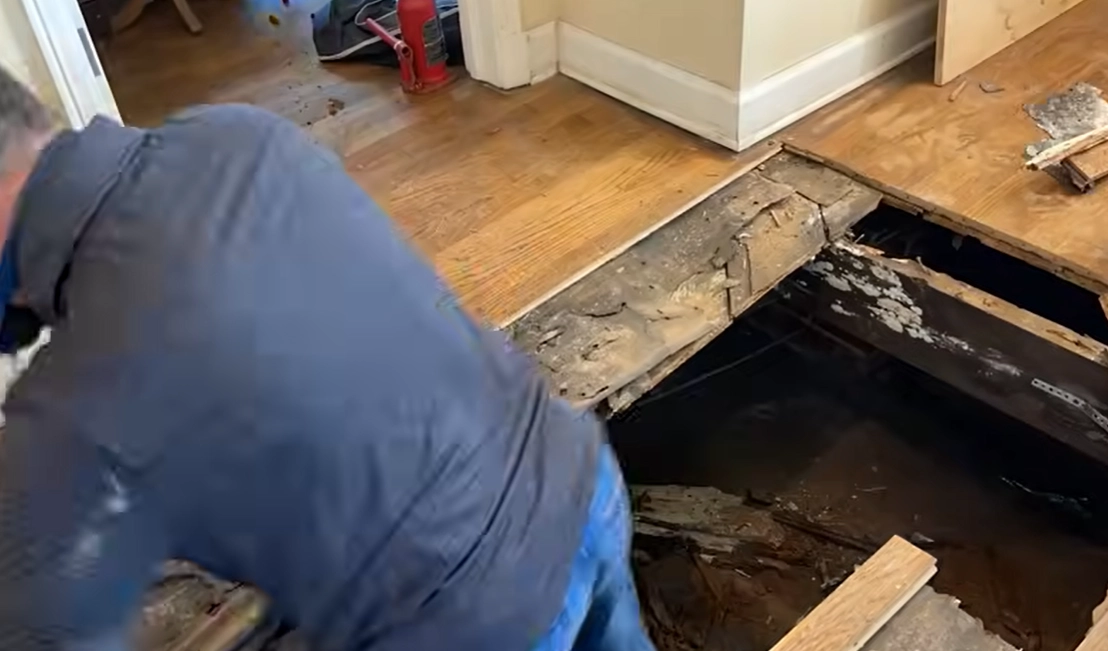
Crawlspace problems announce themselves late. By the time you smell mustiness indoors or notice floors feeling soft, the crawlspace has usually been wet for months.
Wood moisture above roughly 20% feeds mold and rot, and USDA research has ranked Memphis crawlspaces among the worst nationally for wood moisture. A high water table, clay-heavy soils, and 60–80% summer humidity mean many Mid-South crawlspaces never truly dry out — add a slow, unseen plumbing leak and you get fungal growth on joists, sagging subfloors, and indoor air problems.
The professional fix has two parts, and the order matters:
First, kill the moisture source. A vapor barrier over bare earth, sealed vents, and fixing the plumbing leak or drainage problem feeding it. Spraying fungus without doing this is decoration — it comes back, because the moisture never left.
Second, encapsulate. Crawlspace encapsulation seals the space with a heavy-duty vapor barrier and conditioned, dehumidified air — changing the environment the joists live in, not just painting over the symptoms.
If you’re dealing with fungal growth in a Memphis-area crawlspace, don’t start with the cleaning products. Start with the moisture. Call (901) 286-9686 to request a crawlspace assessment and ask about encapsulation options.
Sump pumps, French drains, and encapsulation: what actually keeps water out
Once the water is out, the question is how to keep it out. These solutions solve different problems — a contractor who sells you one without diagnosing which problem you have is selling, not solving.
| Solution | What it does | Best for | Memphis note |
|---|---|---|---|
| Sump pump (with battery backup) | Collects groundwater under the slab and pumps it out before it rises through the floor | Basements sitting below a high water table; storms that knock out power | In Midtown’s high-water-table neighborhoods, this is often the backbone of the whole system — and the battery backup matters, because the power fails exactly when the pump is needed most |
| Interior French drain | A perimeter channel inside the basement that catches seepage and routes it to the sump | Hydrostatic pressure pushing water up through floor cracks and the wall-slab seam | The retrofit-friendly option for older Midtown and East Memphis basements |
| Exterior drainage / waterproofing | Intercepts water outside, before it ever reaches the foundation wall | New construction or full-excavation projects; walls taking direct lateral pressure | Effective but disruptive — the yard gets excavated |
| Crawlspace encapsulation | Sealed vapor barrier + conditioned air that breaks the moisture cycle | Chronic dampness, fungal growth, and wood rot in vented crawlspaces | Answers the USDA moisture problem — changes the environment instead of fighting symptoms |
| Grading and gutters | Moves surface water away from the foundation before it becomes groundwater | Every home, but especially clay-soil lots | With Germantown’s clay soil, proper grading isn’t optional — it’s the first line of defense |
A word of caution: sealing basement walls from the inside — paint-on sealers, crack injections alone — without addressing where the water is coming from is the most common way people pay for waterproofing twice. The fix has to manage the water, not just hide it.
Ask about sump pumps, French drains, and crawlspace encapsulation when you call (901) 286-9686.
What does basement and crawlspace water damage cost?
There is no published Memphis-specific price dataset, so what follows are national benchmarks for planning — your real number comes from a written, on-site assessment.
Nationally, homeowners pay an average of about $3,860 for water damage restoration, with most jobs between $1,380 and $6,370 (Angi, 2026 data). Pricing is driven by water category: Category 1 clean water runs roughly $3–$4 per square foot, Category 2 gray water $4–$6.50, and Category 3 contaminated water — storm flooding, sewage — $7–$7.50+ per square foot, since every porous material below the water line must be removed and disinfected. Reconstruction adds roughly $20–$37 per square foot depending on finishes.
Basement jobs have their own cost logic: finished basements mean more material to remove — drywall flood cuts, carpet pad, insulation — and older Midtown basements with original materials can cost more to restore than modern ones. Crawlspace encapsulation is a separate project whose cost varies with size, access, and condition; it requires on-site measurement, so treat any flat quote with suspicion.
And the cost of waiting: every 24 hours of standing water in 60–80% humidity adds secondary damage, and clean water that sits can be reclassified to a higher category. The cheapest restoration is the fastest one.
Get your honest figure in writing — call (901) 286-9686 and ask about a line-item assessment. For how estimates work and what inflates them, see our honest water damage cost guide.
Will insurance cover a flooded basement or crawlspace?
Sometimes — and the answer almost always comes down to where the water came from.
Sudden, internal events — a burst supply line, a failed water heater, an appliance overflow — are typically covered by standard homeowners insurance. External flooding and groundwater seepage are not. That’s the exclusion that surprises Memphis homeowners: stormwater pushing up through a basement floor, or Nonconnah Creek backwater reaching a foundation, falls outside a standard policy. Separate NFIP flood insurance covers external flooding — worth understanding long before the water comes.
Two things decide claims: documentation (photograph everything before anything moves; keep any professional assessment and moisture readings) and speed (mitigate immediately — insurers penalize delays). Gradual damage is usually denied, which is one more reason a damp crawlspace shouldn’t be ignored.
For the full playbook — sudden vs. gradual, deductible math, adjuster scripts — read our insurance claims guide.
How Memphis homeowners prevent the next flood
Prevention is cheaper than restoration. The seasonal checklist that matters in the Mid-South:
- Grade soil away from your foundation. On clay soil especially, standing water against the wall becomes hydrostatic pressure against it.
- Clean gutters and extend downspouts. Clogged gutters overflow at the foundation; downspouts should discharge well away from the house, not at the basement corner.
- Test your sump pump before storm season (peak rainfall runs April–September). Pour water in the pit, watch it pump, and confirm the battery backup holds a charge.
- Consider a backwater valve if your area has combined sewers — it stops municipal sewage from backing up into your basement during heavy rain.
- Seal foundation cracks and cover window wells. Small entry points become big ones under hydrostatic pressure.
- Know where your main water shutoff is. Every minute of flow adds square footage to the bill.
- Use water leak detectors in the basement, laundry, and under sinks — cheap insurance against the slow leak that becomes a crawlspace disaster.
For the full seasonal playbook — spring storm prep, freeze prep, gutters and grading — see how to prevent water damage.
Basement & crawlspace questions — straight answers
Each question below is an H2 with a precise answer. These are the verbatim questions homeowners actually ask.
What should I do if my basement is flooding?
Stay out of standing water if there’s any chance of electrical contact — never touch water near outlets or a submerged breaker panel. If safe, shut off electricity to the area. Stop the source if it’s a burst pipe (your main shutoff valve). Photograph everything for insurance before moving anything, then call (901) 286-9686 to request emergency water removal. Don’t wait for it to dry on its own — water inside walls and subfloors won’t.
How long does it take to dry a flooded basement?
Typically 3 to 5 days with professional drying equipment — industrial air movers and dehumidifiers — depending on water depth, materials, and humidity. Concrete and framing dry slower than you’d expect, and “feels dry” isn’t dry. Professional drying is verified with moisture meters and drying logs, which is what separates a real dry-out from a fan and a hope. Reconstruction of removed drywall and flooring adds time after that.
Is it safe to live in a house with a flooded basement?
Often not until it’s professionally dried. Storm runoff and sewage backup are Category 2–3 contaminated water; standing water near electrical systems is a shock hazard; and in Memphis’s 60–80% summer humidity, mold can start within 24 to 48 hours. Request a professional moisture assessment before deciding to stay, and ask which areas are safe to occupy while drying is underway.
How do I stop my basement from flooding in heavy rain?
Grade soil away from your foundation (critical with Germantown’s clay soil), keep gutters clean with downspouts extended away from the house, and maintain a sump pump with battery backup — tested before the April–September storm season. For hydrostatic pressure pushing up through the floor, an interior French drain routed to the sump is the standard fix. If your area has combined sewers, ask about a backwater valve.
Need advice on cleaning fungus and mold from crawl space…
Fix the moisture before the mold. Find and stop the source first — a plumbing leak, groundwater intrusion, or humid air through open vents — because surface cleaning without drying the crawlspace means the growth returns. USDA data ranks Memphis crawlspaces among the worst nationally for wood moisture: this is a climate problem, not a cleaning problem. The long-term professional approach is encapsulation — a sealed vapor barrier with conditioned, dehumidified air. Call (901) 286-9686 to request a crawlspace assessment.
Who can fix French drains and seal basements in Bartlett that you all recommend and have experience with?
French drain installation and basement sealing services are available across Bartlett and Shelby County — call (901) 286-9686 to request one. When vetting any contractor for this work, ask about their experience with suburban basements and clay-influenced soils, insist on a written line-item estimate (never a verbal range), and make sure the plan addresses where the water comes from — grading and drainage — not just sealing cracks from the inside.
Water in your basement or crawlspace? Don’t wait it out.
Every hour it sits is more damage, more mold risk, and a harder insurance conversation. Services are available across Memphis, Bartlett, Germantown, and the Mid-South.
Call (901) 286-9686 to request help
Memphis Water Damage Restoration · 4040 Delp St, Memphis, TN 38118 · Serving Shelby County & the Mid-South