Hardwood Floor Water Damage in Memphis, TN
Hardwood floors and standing water are on a collision course — and in Memphis, where indoor humidity sits between 60 and 80% for much of the year, that collision plays out faster than most homeowners expect. A supply-line leak, a storm intrusion, a slow appliance drip: water plus hardwood plus Memphis humidity is a race against the clock. Here’s how to read what your floor is telling you, what can honestly be saved, and what proper drying looks like.
Water damage restoration services are available across Memphis and Shelby County. Call (901) 286-9686 to request an assessment. If you’re noticing the early signs of water damage, don’t wait for the floor to make the decision for you.
Cupping, crowning, buckling: reading your floor
Your floor is already telling you what happened — you just need the vocabulary:
- Cupping — the edges of each board rise higher than the center, curling into a shallow cup. The classic sign of moisture coming from below: a damp subfloor, crawlspace humidity, or water wicking upward. This is the early-warning stage.
- Crowning — the opposite: the center of the board rises higher than the edges. Often caused by moisture from above (a surface spill that soaked in) — or by sanding a cupped floor before it finished drying, one of the most expensive mistakes in floor restoration.
- Buckling — boards lift off the subfloor entirely, sometimes tenting into the air. The floor has expanded beyond what the fasteners can hold. This is severe damage, not a drying problem.
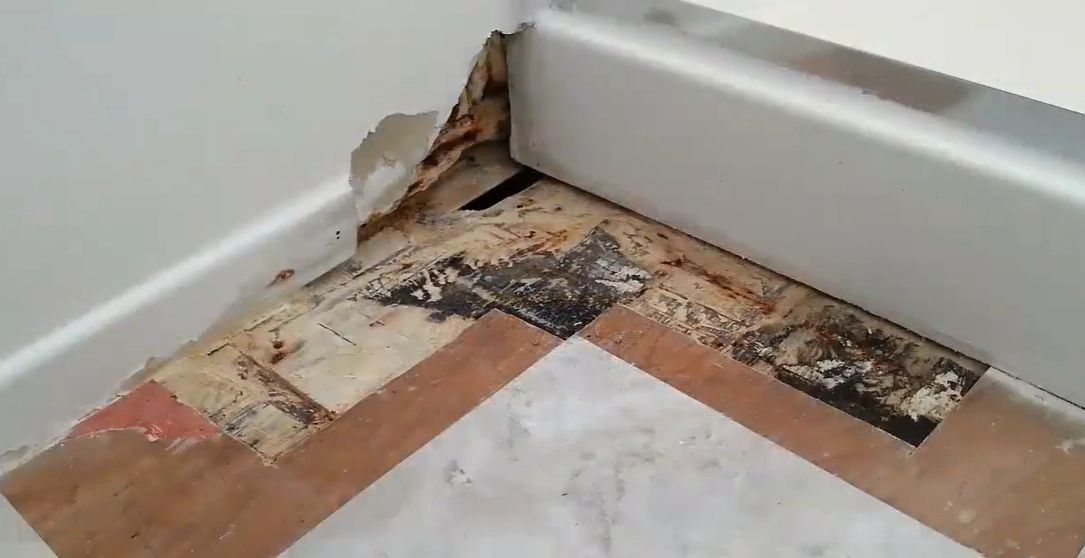
- Black staining — dark discoloration, usually along board edges: tannins reacting with water and metal fasteners, or the early footprint of mold taking hold in the wood.
Cupping caught early can often be dried back flat. Crowning and buckling are progressively harder news — which is why the drying window matters so much.
Can water-damaged hardwood be saved?
Honest answer: sometimes, and it depends on four things. Anyone who promises to save your floor from a photograph is guessing.
- How long it stayed wet. A surface spill wiped up in minutes is usually harmless. Standing water for hours drives moisture deep into boards and subfloor — and every hour in Memphis humidity works against you.
- The category of water. Clean supply-line water is a drying question. Gray or black water — sewage backups, floodwater — is a health question: contaminated water soaked into hardwood means replacing the affected boards, not drying them.
- Solid vs. engineered. Solid hardwood can be sanded and refinished multiple times over its life. Engineered flooring has a thin veneer with limited — sometimes zero — sanding tolerance. Once the veneer is compromised, that section is done.
- Subfloor condition. If the subfloor is swollen, rotted, or growing mold, the finish floor has to come up regardless of how the top looks. Drying a pretty surface over a ruined subfloor just hides the problem.
The through-line: fast professional assessment beats optimism. Moisture meters don’t guess — they tell you exactly how deep the water went.
How professionals dry hardwood floors
Proper hardwood drying is a measured process, not a fan-and-hope operation:
- Moisture mapping first. Pin and pinless meters map how deep moisture penetrated — boards, subfloor, and the surrounding area. Surface readings lie; the meter tells the truth.
- Specialty drying mats and panels. Negative-pressure mat systems pull moisture out of the wood and subfloor rather than just blowing air across the top.
- Dehumidification. In Memphis’s 60–80% humidity, you cannot dry a floor into wet air. Controlling the room’s humidity is what lets the wood release its moisture.
- Patience, verified by meters. Drying takes days, and “done” is declared by moisture-content readings returning to normal — not by touch, not by looks.
- Never sand early. Sanding a cupped floor before it’s fully dry is how crowning happens. The floor must be flat and dry before any refinishing begins.
How long the whole process takes depends on the extent of saturation — our restoration timeline guide walks through what each phase looks like.
Refinish or replace? The honest math
Refinishing makes sense when: boards dried flat and stable, staining is surface-level only, the veneer (on engineered floors) is intact, and the subfloor is sound. Nationally, refinishing typically costs a fraction of full tear-out and replacement — but the only number that matters for your floor is a written on-site estimate.
Replacement of affected boards or areas makes sense when: buckling has occurred, black staining runs through the board, the water was contaminated, or the subfloor is damaged. Replacement boards get laced into the existing floor and the area refinished to blend.
Either way, get the drying done right first — refinishing over residual moisture guarantees a callback. For what drives restoration pricing generally, see our water damage restoration cost guide.
Hardwood floor water damage questions — straight answers
What does cupping mean on a hardwood floor?
Cupping is when the edges of each board rise higher than the center, so the board curls into a shallow cup shape. It almost always means moisture is coming from below — a damp subfloor, crawlspace humidity, or water wicking upward. It’s the floor’s early-warning signal: caught fast, professional drying can often flatten boards back out; ignored, it progresses to crowning or buckling.
Can buckled hardwood floors be fixed without replacing them?
Honestly, rarely. Buckling means boards have lifted off the subfloor — the wood expanded past what the fasteners can hold, and that deformation doesn’t reverse with drying. The affected boards usually need replacement, laced into the existing floor and refinished to blend. Anyone promising to dry a buckled floor back to flat is selling hope, not physics.
How long before water permanently ruins hardwood?
There’s no single number — it depends on the wood species, the finish, and how much water. A surface spill wiped up in minutes is usually harmless. Standing water for hours drives moisture deep into boards and subfloor, and in Memphis’s 60–80% humidity, mold can start within 24 to 48 hours. The practical rule: the faster extraction and drying start, the more floor you keep.
Should I run fans on my wet hardwood floor?
Household fans alone usually do more harm than good — they dry the surface while the core and subfloor stay wet, which can worsen cupping. Proper hardwood drying pairs controlled airflow with dehumidification and moisture-meter verification, and it never starts with sanding. If the water was contaminated (sewage, floodwater), skip the fans entirely and call (901) 286-9686 — that’s a replacement and sanitization job, not a drying job.
Hardwood floor water damage? Get an honest read first.
Cupping, crowning, staining — whatever your floor is showing, the next step is finding how deep the moisture went and drying it properly before anyone talks about sanding. Call (901) 286-9686 to request an assessment anywhere in Memphis and Shelby County.
Memphis Water Damage Restoration · 4040 Delp St, Memphis, TN 38118 · (901) 286-9686 · Serving Memphis, Shelby County & the Mid-South